The short answer
You likely need a new AC if yours needs frequent major repairs, can't keep up on hot afternoons, or your home has no cooling at all. ChillPro AC Repair checks your home's cooling needs, ducts, and electrical system. Then we explain your options for repair, AC replacement, or a heat pump and give you a written quote.
Summers in the Santa Clara Valley are dry, and inland and southern parts of San Jose can run noticeably hotter than neighborhoods closer to the Bay. If your air conditioner is struggling or failing, or you want to add cooling to a home that never had it, ChillPro AC Repair can help you choose and install a system that fits your house. We serve San Jose and nearby cities including Santa Clara, Campbell, Milpitas, Cupertino, and Los Gatos. This page explains when installation makes sense, what we look at, and what to expect.
Signs You Need a New AC (or Your First One)
Not every AC problem calls for a new system. But some patterns suggest that a replacement or a first-time installation is worth considering:
If one or two of these apply, a diagnostic visit usually tells you whether a repair will keep the system running reliably for a while or whether you should plan for a new system before the next heat wave.
- Your system needs repeated repairs, especially to major parts like the compressor or coil
- Rooms stay warm on hot afternoons, even when the thermostat is set low and the system runs constantly
- Summer energy bills climb even though you use the house the same way
- The system uses an older refrigerant that is being phased out and is getting harder to service
- You hear grinding, banging, or loud buzzing, or you see ice on the refrigerant lines
- Your home has no central cooling and recent summers have been uncomfortable
- Your furnace is also near the end of its life, and you want to plan heating and cooling together
What We Check Before Recommending a System
A new AC should be sized and set up for your specific house. It shouldn't be picked off a chart based on square footage alone. Before we recommend equipment, we look at:
An oversized system cools quickly but turns on and off too often. That can leave the house clammy and wear out parts faster. An undersized system runs all afternoon and still falls behind. Getting the size right matters more than the brand name on the box.
- Cooling load: insulation, window size and direction, ceiling height, and how much afternoon sun the house gets
- Ductwork: size, condition, leaks, and whether the existing ducts can deliver enough air to each room
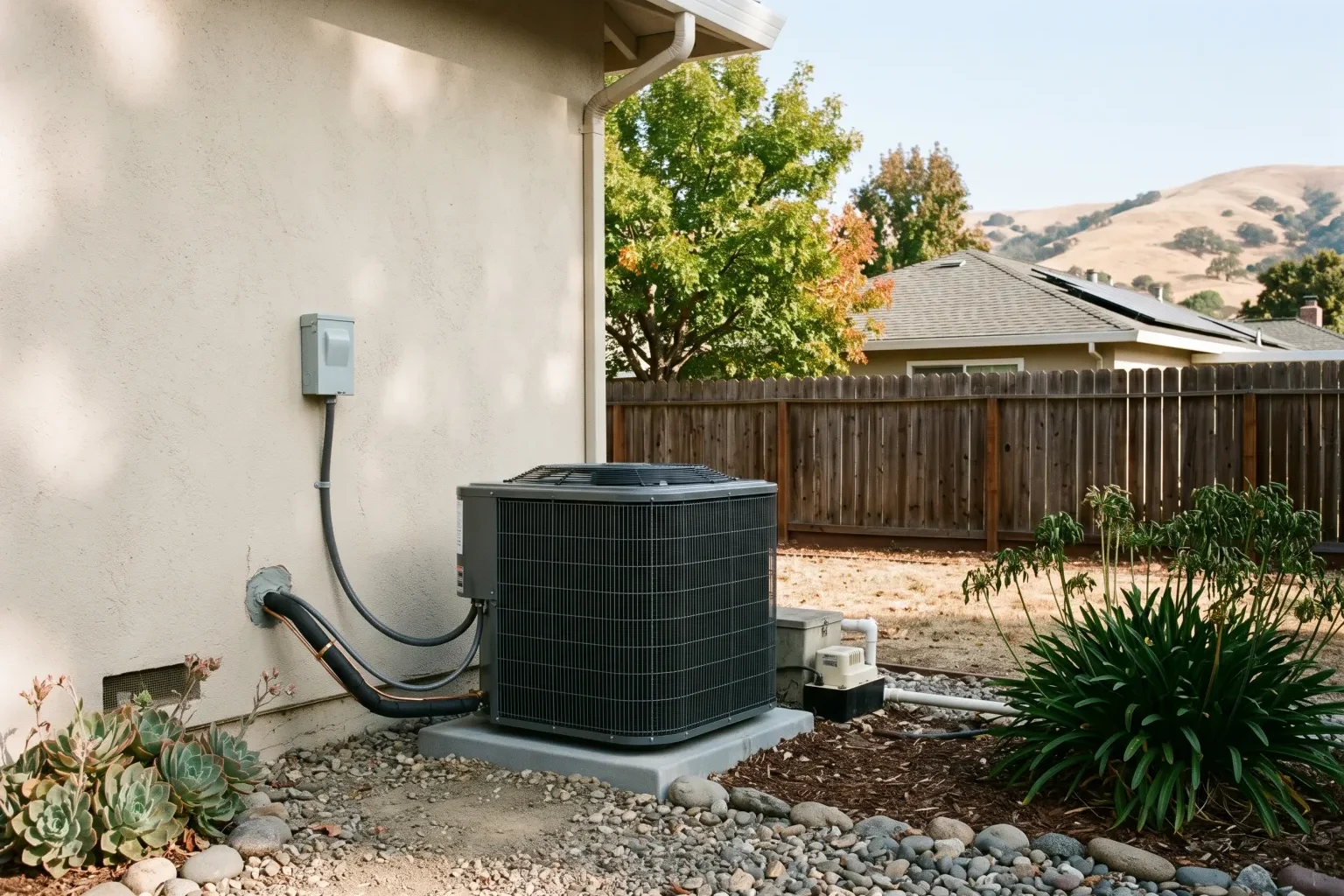
- Electrical capacity: the panel and circuit that will power the outdoor unit
- Placement: where the outdoor unit can sit with proper clearance and reasonable noise for you and your neighbors
- Existing equipment: the furnace or air handler, thermostat, and refrigerant lines, and whether any of them can be reused
- Drainage: how condensation from the system will be drained safely
Repair, Replace, or Switch to a Heat Pump
When your current AC has a problem, you usually have three paths. A repair makes sense when the system is in reasonable shape and the fix is limited. Examples include a failed capacitor, a bad fan motor, or a refrigerant leak that can be found and fixed. Replacing just the AC is an option when your furnace still works well and is compatible with a new outdoor unit.
The third path is replacing your AC with a heat pump, which cools in summer and heats in winter. Winters in the Santa Clara Valley are mild and damp, so a heat pump can handle much or all of a home's heating. Local air rules are another reason to consider one. Under Bay Area Air District rules, natural gas furnaces manufactured from 2029 on must meet a zero-NOx emission standard. In practice, that points homeowners toward heat pumps when they replace a furnace after that date.
Those rules do not require you to replace working equipment. They apply only when an existing furnace or water heater fails or is replaced. There's no need to remove a furnace that's doing its job. But if both your AC and furnace are getting old, a heat pump may be the more practical long-term choice. We'll explain the trade-offs for your home and let you decide.
What Affects the Cost
We quote every installation after we see the home, because the final cost depends on several factors:
Incentives can also change the picture. The federal Energy Efficient Home Improvement Credit only covered qualifying heat pumps placed in service before December 31, 2025, so it isn't available for new installations now. Bay Area homeowners can check BayREN and their local clean energy provider for current heat pump and electrification incentives. Amounts and availability change with each funding cycle, so we confirm the current offer before including it in a quote.
- System type: a central AC alone, a heat pump, or a ductless mini-split
- The size and efficiency rating of the equipment
- Whether ductwork needs repair, resizing, or replacement, or has to be added for the first time
- Electrical work, including panel upgrades or a new dedicated circuit
- Whether the indoor coil, refrigerant lines, or thermostat need to be replaced
- Access: attics, crawl spaces, and the distance between the outdoor unit and the indoor equipment
- Permits and inspections required by your city
How an Installation Visit Works
First, we schedule an in-home assessment. A technician looks at your current system, ductwork, electrical panel, and the layout of the house. They'll also ask about rooms that are hard to cool and how you use the space.
Next, we walk you through your options in plain terms, including a repair if that's a reasonable choice. You'll get a written quote that spells out the equipment and the work involved, and you can take time to think it over.
On installation day, the crew protects floors and work areas, removes the old equipment, and installs and connects the new system. We also handle any permit and inspection steps your city requires. Before we leave, we test the system and check airflow and refrigerant levels. Then we show you how to use the thermostat and explain basic upkeep, like changing filters and keeping the outdoor unit clear of leaves and debris.
AC Installation by city
- AC Installation in Campbell
- AC Installation in Santa Clara
- AC Installation in Cupertino
- AC Installation in Saratoga
- AC Installation in Monte Sereno
- AC Installation in Los Gatos
- AC Installation in Sunnyvale
- AC Installation in Milpitas
- AC Installation in Los Altos
- AC Installation in Mountain View
- AC Installation in Los Altos Hills
- AC Installation in Fremont